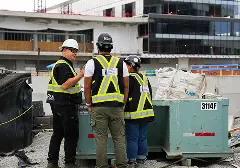
Concrete removal projects generate some of the heaviest construction waste handled on Metro Vancouver job sites. Whether you are removing a driveway, patio, retaining wall, sidewalk, footing, foundation, or commercial slab, selecting the right bin involves much more than estimating how much broken concrete will fit inside.
Unlike lighter renovation debris, concrete often reaches transportation weight limits before a container appears full. The type of concrete, reinforcement, attached soil, loading method, site access, and receiving-facility requirements can all influence which bin is appropriate for the project.
Planning these details before demolition begins helps reduce unnecessary delays, overloaded containers, additional hauling, rejected loads, and unexpected disposal costs.
Here is the Quick Answer:
Before ordering a concrete removal bin:
- estimate the concrete dimensions before demolition;
- identify whether the concrete contains rebar or wire mesh;
- disclose any attached soil, asphalt, brick, or other materials;
- choose a heavy-material bin rather than simply the largest container available;
- consider how the material will be loaded;
- confirm there is adequate delivery and pickup access;
- follow the approved loading level rather than filling the container to the top;
- plan staged exchanges where multiple loads are expected;
- keep concrete separate from other waste streams unless approved.
For most concrete projects, transportation weight—not available container volume—is the primary factor that determines the appropriate bin.
Why Concrete Bin Selection Is Based on Weight, Not Just Volume
Concrete behaves differently from most renovation debris.
Materials such as drywall, wood, insulation, and packaging normally fill a container long before transportation weight becomes an issue. Concrete often does the opposite. A container may still appear to have significant unused space while already approaching the planned hauling weight.
Moisture, reinforcing steel, attached soil, asphalt, brick, and other materials can increase the total load even further.
Because commercial vehicles operating in British Columbia remain subject to transportation-weight requirements, dispatch planning considers far more than how much empty space remains inside the container.
For a more detailed explanation of transportation weight and loading practices, see Peak Disposal’s guide to avoiding overweight loads on concrete bins.
Which Peak Disposal Bins Are Commonly Used for Concrete?
Heavy concrete projects are generally planned using smaller roll-off bins designed for dense materials.

8-Yard Concrete Bin
Dimensions: 15’ × 8’ × 2’
An 8-yard container may be appropriate for projects such as:
- smaller patio removals;
- walkway demolition;
- staged concrete removal;
- smaller foundation sections;
- projects where controlled loading is preferred.
Its lower profile may support loading by hand, wheelbarrow, or suitable equipment, subject to site conditions and Peak Disposal’s loading instructions.
However, suitability depends on the estimated concrete quantity, reinforcement, loading method, transportation requirements, and the loading instructions provided by Peak Disposal.
For complete specifications, see the 8-Yard Dumpster Dimensions & Capacity guide.
10-Yard Concrete Bin
Dimensions: 16’ × 8’ × 2.5’
A 10-yard container may be appropriate for:
- somewhat larger demolition projects;
- driveway removal completed in planned stages;
- larger patios;
- commercial concrete removal requiring additional container volume while still using a heavy-material bin.
As with every heavy-material project, the container should only be loaded according to the approved loading plan rather than visual capacity alone.
For complete specifications, see the 10-Yard Dumpster Dimensions & Capacity guide.
Why Larger Bins Are Usually Unsuitable for Full Concrete Loads
At first glance, a 20-yard, 30-yard, or 40-yard bin may seem like the obvious choice because it provides considerably more volume.
For concrete, however, larger volume rarely translates into greater usable capacity.
A large container filled with concrete can exceed transportation limits long before it appears full. For that reason, concrete projects are typically planned using smaller heavy-material bins and, where necessary, multiple scheduled loads or exchanges.
The same transportation-weight principle applies throughout heavy-material hauling: the correct container is determined by the approved load, not by how much visible space remains.

Project Details That Help Determine the Right Bin
Every concrete removal project is different. Before recommending a container, Peak Disposal may ask about several project details.
Amount of Concrete
Estimate the approximate:
- length;
- width;
- thickness;
- number of concrete sections.
Knowing only the surface area is rarely enough because slab thickness can significantly affect the amount of material generated.
Type of Concrete
Different projects may involve:
- plain concrete;
- reinforced concrete;
- concrete blocks;
- poured foundations;
- sidewalks;
- retaining walls;
- driveways;
- structural slabs.
The material type influences handling, loading, transportation, and receiving requirements.
Reinforcement
Concrete containing rebar or wire mesh should be disclosed before ordering.
Reinforcement may affect:
- loading procedures;
- handling requirements;
- receiving-facility acceptance;
- transportation planning.
Protruding steel should never extend beyond the container.
Size of Broken Pieces
Large concrete sections can be difficult to load evenly.
Breaking material into manageable pieces generally supports:
- safer loading;
- more even weight distribution;
- reduced risk of damaging the container;
- more efficient use of available space.
Attached Materials
Concrete may arrive with:
- soil;
- asphalt;
- gravel;
- brick;
- vegetation;
- construction debris.
These materials can affect both transportation weight and receiving-facility acceptance.
Loading Equipment
Peak Disposal may ask how the concrete will be loaded, such as by:
- hand;
- wheelbarrow;
- mini excavator;
- skid steer;
- larger excavation equipment.
Knowing the loading method helps determine suitable container placement and loading instructions.
Site Access
Safe delivery and collection also depend on site conditions, including:
- driveway width;
- truck turning space;
- overhead utilities or branches;
- stable ground;
- street access;
- available loading space.
Providing accurate access information before delivery helps avoid delays on collection day.

One Bin or Multiple Loads?
Many contractors initially assume one larger container will always be more efficient.
In practice, several planned exchanges using heavy-material bins may provide a safer and more predictable hauling plan than attempting to place an entire demolition project into one container.
The total number of loads, bin exchanges, material condition, and receiving requirements can also affect concrete disposal costs in Metro Vancouver.
Multiple exchanges may be appropriate when:
- demolition is completed in stages;
- site access limits storage space;
- loading continues throughout the day;
- transportation weight becomes the controlling factor;
- project scheduling requires continuous removal.
Planning exchanges in advance also helps crews avoid waiting for containers during active demolition.
Keep Concrete Separate From Other Materials
Source-separated concrete generally offers the greatest flexibility during hauling and receiving.
Unless specifically approved, concrete should not be mixed with:
- soil;
- asphalt;
- brick;
- wood;
- drywall;
- insulation;
- household garbage;
- liquids;
- hazardous materials.
Mixed loads may require different handling procedures, reduce recycling opportunities, attract different fees, or be rejected by receiving facilities.
For further guidance on dense material streams, see Peak Disposal’s overview of dirt and concrete bin rentals and overweight-load prevention.
Metro Vancouver’s Disposal Ban Program restricts inert fill materials—including concrete, soil, sod, gravel, and asphalt—from disposal as general garbage when they exceed 0.5 cubic metres per load. Appropriate receiving arrangements should therefore be confirmed before demolition begins.

Loading Concrete Safely and Correctly
Once the container has been delivered:
- follow the loading instructions provided for the project;
- distribute material as evenly as practical;
- keep all concrete below the container walls;
- do not rely on remaining empty space as an indication that additional concrete can be added;
- avoid adding unapproved materials;
- keep access clear for pickup;
- stop loading when the planned quantity has been reached;
- contact Peak Disposal if project conditions change.
Breaking, drilling, cutting, or grinding concrete can generate respirable crystalline silica. Contractors remain responsible for implementing appropriate exposure-control measures and complying with applicable WorkSafeBC requirements during demolition activities.
Common Bin-Selection Mistakes
Common planning mistakes include:
- choosing the largest container based only on volume;
- estimating slab area without considering thickness;
- failing to disclose reinforcement;
- mixing concrete with soil or general construction debris;
- assuming one container will handle every project;
- filling the container to the rim without following loading instructions;
- dropping oversized concrete sections into the bin;
- overlooking delivery or pickup access;
- changing the material stream after delivery;
- relying on generic online capacity estimates rather than project-specific guidance.
Most of these issues can be avoided through accurate project information and early coordination.
How to Estimate Your Project Before Calling Peak Disposal
Having a few details ready before ordering helps Peak Disposal recommend a suitable hauling plan.
Prepare the following information:
- project location;
- type of concrete being removed;
- approximate length, width, and thickness;
- whether reinforcement is present;
- whether soil, asphalt, or other materials are attached;
- loading equipment;
- site access;
- preferred delivery date;
- whether staged exchanges may be required;
- any known receiving-facility requirements.
Providing this information early helps reduce unnecessary scheduling changes later.

How Peak Disposal Supports Concrete Removal Projects
Peak Disposal helps contractors, builders, landscapers, property managers, renovators, and homeowners coordinate suitable construction bin rental for concrete removal throughout Metro Vancouver.
Support may include:
- discussing the project scope;
- reviewing estimated concrete quantities;
- identifying whether an 8-yard or 10-yard heavy-material bin may be suitable;
- reviewing loading and access conditions;
- explaining project-specific loading instructions;
- coordinating deliveries, exchanges, and pickups;
- planning source-separated concrete loads.
Peak Disposal does not perform structural demolition or replace project planning. Final container selection depends on the information provided by the customer, transportation requirements, loading conditions, and project-specific instructions.
Related Resources
- Dirt and Concrete Bin Rentals: How to Avoid Overweight Fines in BC
- How Contractors Avoid Overweight Loads on Concrete Bins
- Concrete Disposal Costs in Metro Vancouver: What Affects Pricing?
- 8-Yard Dumpster Dimensions & Capacity
- 10-Yard Dumpster Dimensions & Capacity
- Construction Bin Rental
- Our Bins
Need help choosing the right concrete bin?
Every concrete removal project is different.
Tell Peak Disposal what you are removing, the approximate dimensions and thickness, whether the concrete contains reinforcement or attached material, how it will be loaded, and what access is available at the site.
With accurate project information, Peak Disposal can help coordinate a suitable heavy-material bin, loading instructions, and a hauling schedule that matches your project requirements.